 Wild Workation
From Marmaris to Knidos and back
Seven days sailing along one of Turkey's finest coastlines — from the lively marina of Marmaris to the ancient ruins of Knidos at the tip of the Datça Peninsula. Crystal bays, pine-covered hillsides, a touch of history, and enough fast marina Wi-Fi to keep your sprint on track.
Seven-day yacht workation sailing from the Marmaris marina along the Datça Peninsula to the ancient ruins of Knidos and back. From €1,100 per person with the early-bird discount, €1,300 at the standard rate, or €2,000 for a private cabin for two. All-inclusive(except food): Turkish 4G LTE for video calls, fast marina Wi-Fi in Marmaris and Bozburun, private cabins, and a professional skipper. Ideal for remote workers and digital nomads who want stable connectivity for morning Zoom calls and Mediterranean swimming after lunch. The hook: 2,500-year-old Knidos ruins at the tip of the Datça Peninsula, crystal bays lined with pine forest, and the easiest marina access on the Turquoise Coast.
In the fixed price
- A spot on the catamaran (accommodation in a shared double cabin).
- Bedding and Towels
- Skipper services
- Motorboat (dinghy)
- Internet support
Not included
- Air tickets
- Transfer to and from the marina
- Marina fees and provisions
- Sightseeing and onshore entertainment
- Personal spendings
- Damage Policy
The Route
Marmaris — Departure
The starting point — a vibrant marina town with a 16th-century castle, a winding bazaar, and excellent boat provisioning. We depart in the afternoon and anchor in the first quiet bay within a few hours.
Bozburun
A sleepy fishing village on the Hisarönü Gulf, famous for its traditional gulet (wooden schooner) builders. A perfect work morning in the cockpit followed by a swim in calm, crystal-clear water.
Selimiye
A hidden bay framed by pine-covered hills and a small village of whitewashed houses. Excellent snorkelling, a handful of waterfront restaurants, and reliably fast marina Wi-Fi for the afternoon calls.
Palamutbükü
One of the most beautiful wild beaches on the Datça Peninsula — a long pebble shore backed by fig and olive trees. The turquoise water is some of the clearest in the Aegean; a natural recharge between two work days.
Knidos — The Highlight
The jewel of the route — an ancient Greek city at the very tip of the Datça Peninsula, founded in the 4th century BC and famous for the Temple of Aphrodite and its lighthouse. Anchor in one of two natural harbours and explore the ruins at sunset.
Datça
The main town of the peninsula — a relaxed place with good restaurants, a traditional market, and a hammam. Worth a morning at the local café with your laptop before an evening stroll and dinner ashore.
Return to Marmaris
The final passage home — a comfortable 40-mile run, often with a tailwind. One last swim stop in a bay, then back to the marina in time for evening flights.
Deep work in the morning, sailing in the afternoon
Where do we spend our time
Our fleet will consist of one or more comfortable catamarans. On board each one, you’ll find everything needed for living: four or five cabins with comfortable beds and storage, two to three bathrooms with showers and hot water, and a spacious saloon with a kitchen. And of course, Wi-Fi internet.
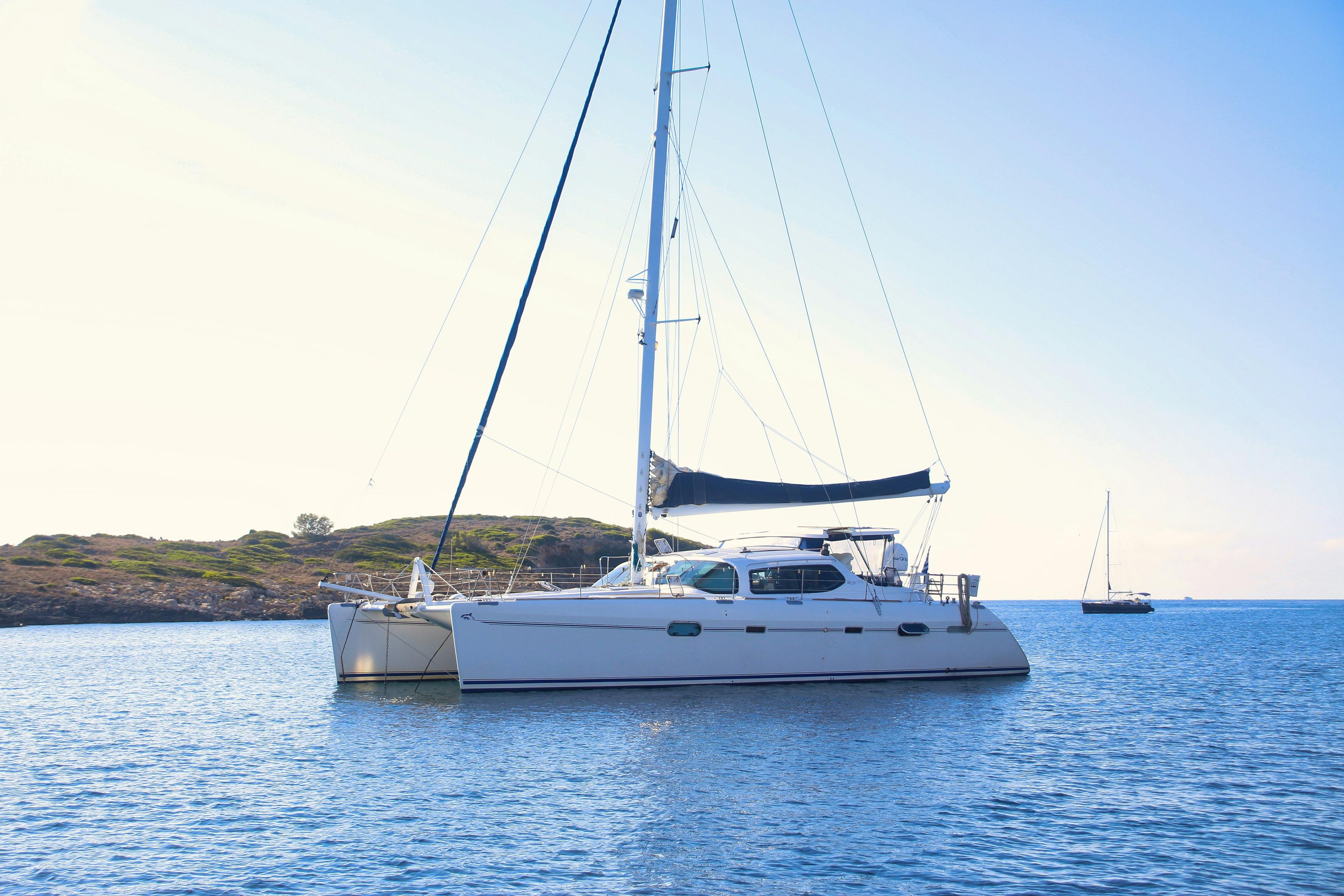
A spacious catamaran
It is more than a boat — it’s a floating living and working environment designed for comfort, balance, and freedom. Wide decks, bright panoramic interiors, and separate living areas create a sense of openness that you rarely feel at sea. Multiple social zones allow people to work, relax, and connect without getting in each other’s way.
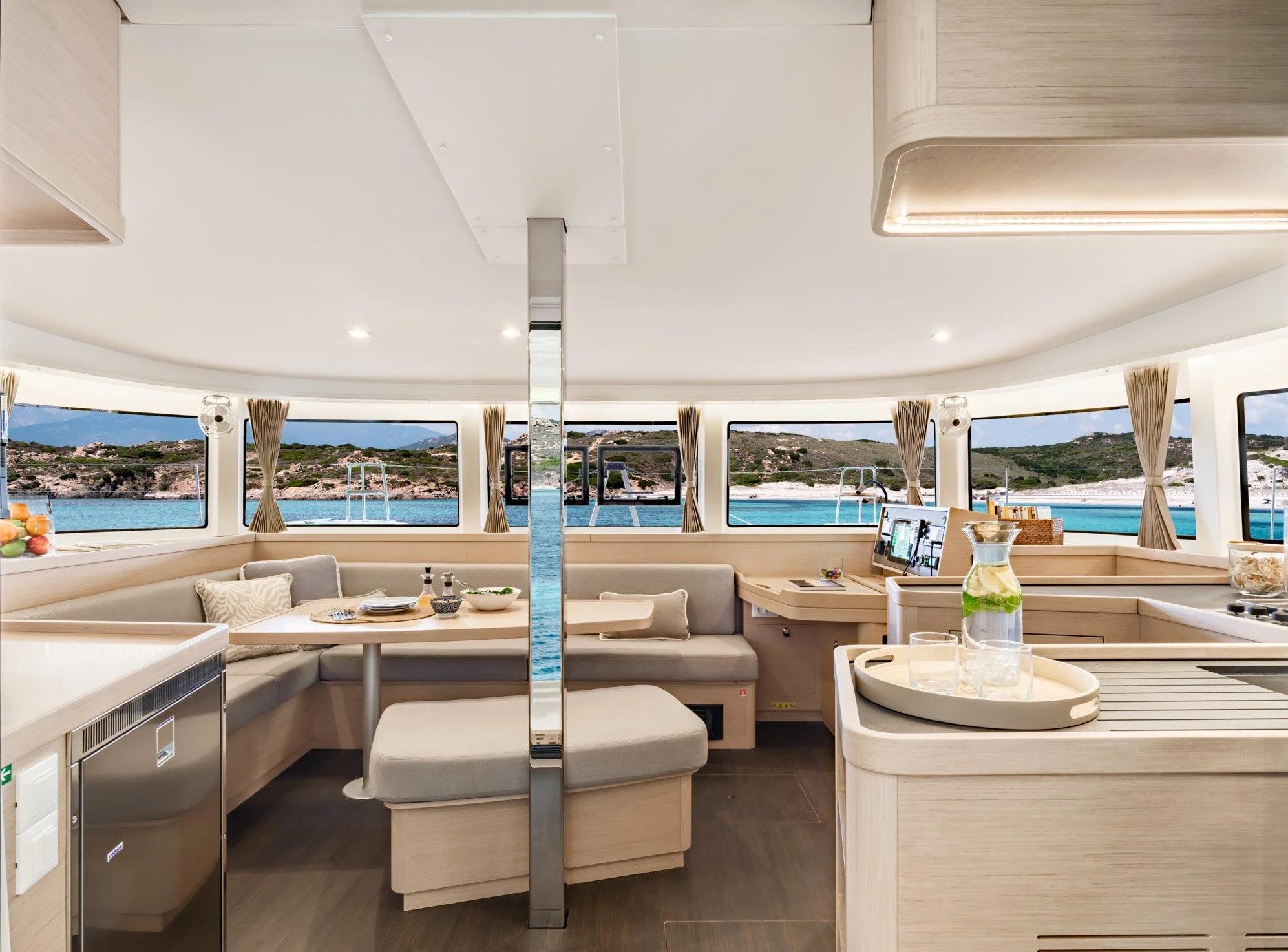
The panoramic saloon
The panoramic saloon is a quiet workspace protected from sun and wind. A large table, a nearby kitchen, and a stable surface for your laptop make it feel like a bright office in the middle of the sea. Perfect for deep-focus work, planning sessions, and long conversations with your team.
Cockpit
The cockpit naturally turns into a coworking area: a large table, shade from the bimini, power outlets, and a steady daily rhythm. This is where work sessions, brainstorms, and sunset dinners happen after tasks are done. The sea is right there, but work doesn’t stop — it just feels lighter. It’s a place where Slack calls can end with a jump into the water, and ideas come faster than they do in an office.
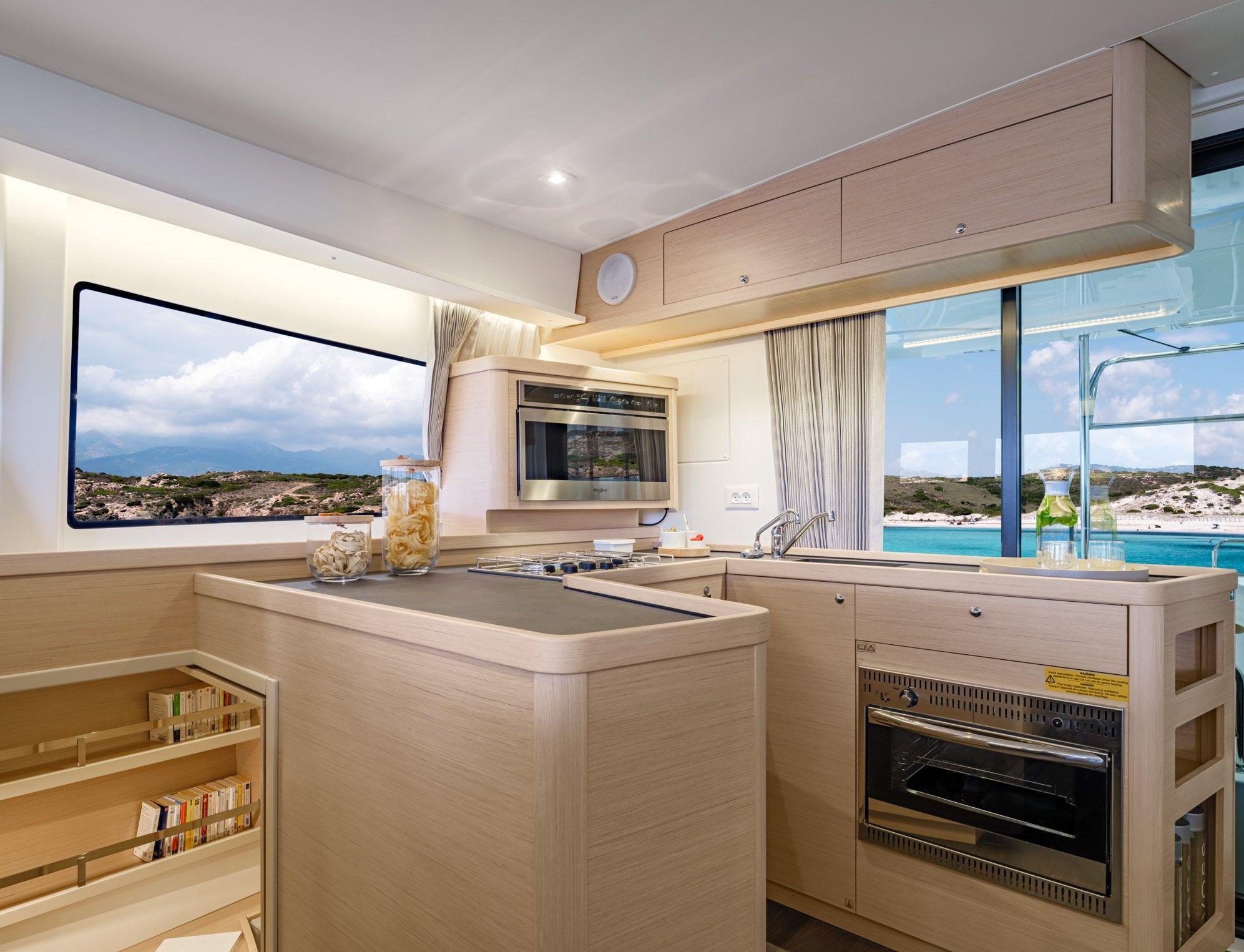
Kitchen area (galley)
It is designed to feel closer to a compact apartment kitchen than a typical boat setup. With generous counter space, a stove, refrigerator, sink, and plenty of storage, cooking on board becomes easy and social rather than purely functional. Because the galley is usually integrated with the saloon and cockpit, it naturally becomes part of daily life on board. You can prepare breakfast while talking with the crew, make coffee between meetings, or cook dinner together after a day of work and swimming.
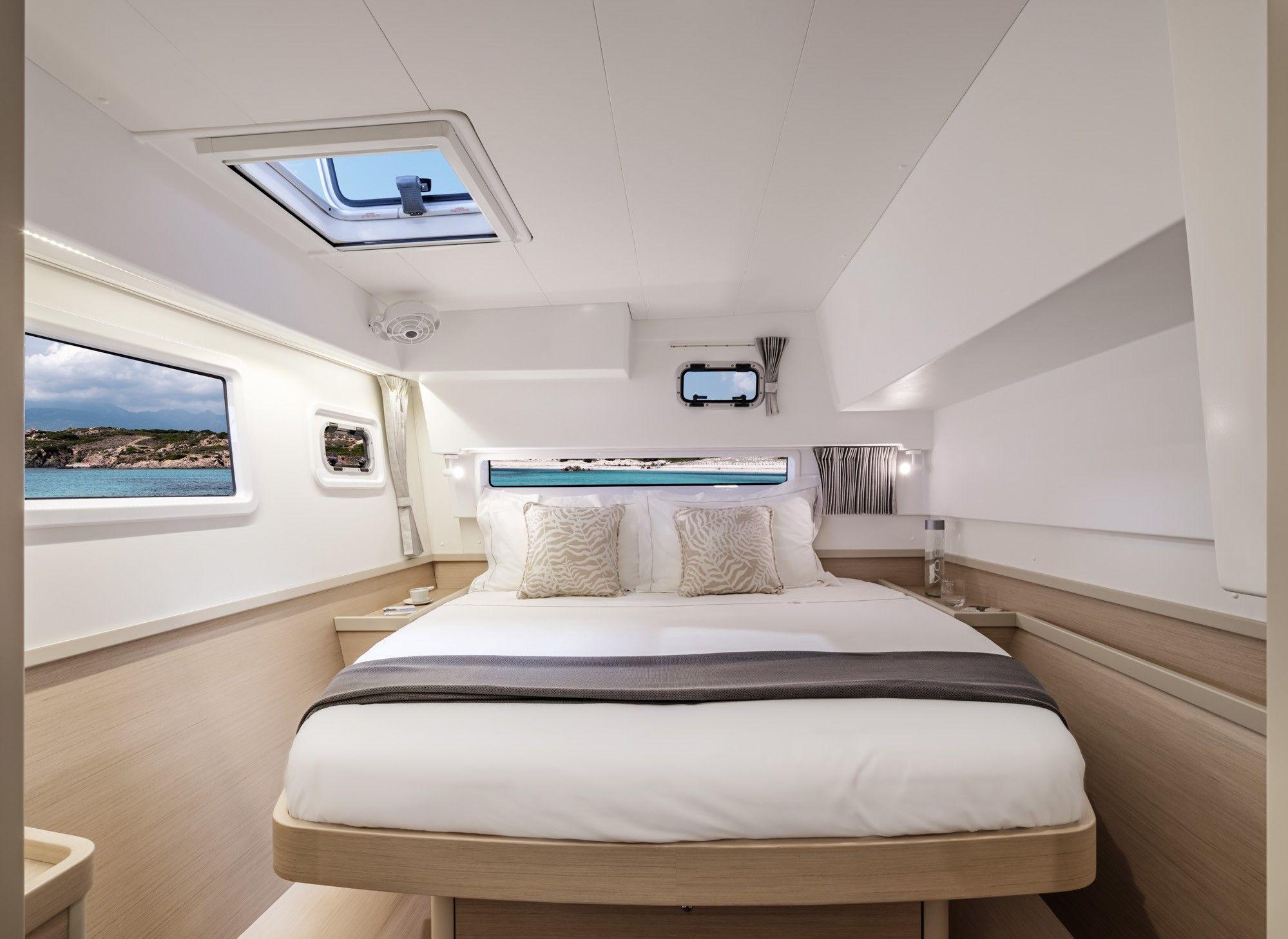
Cabins
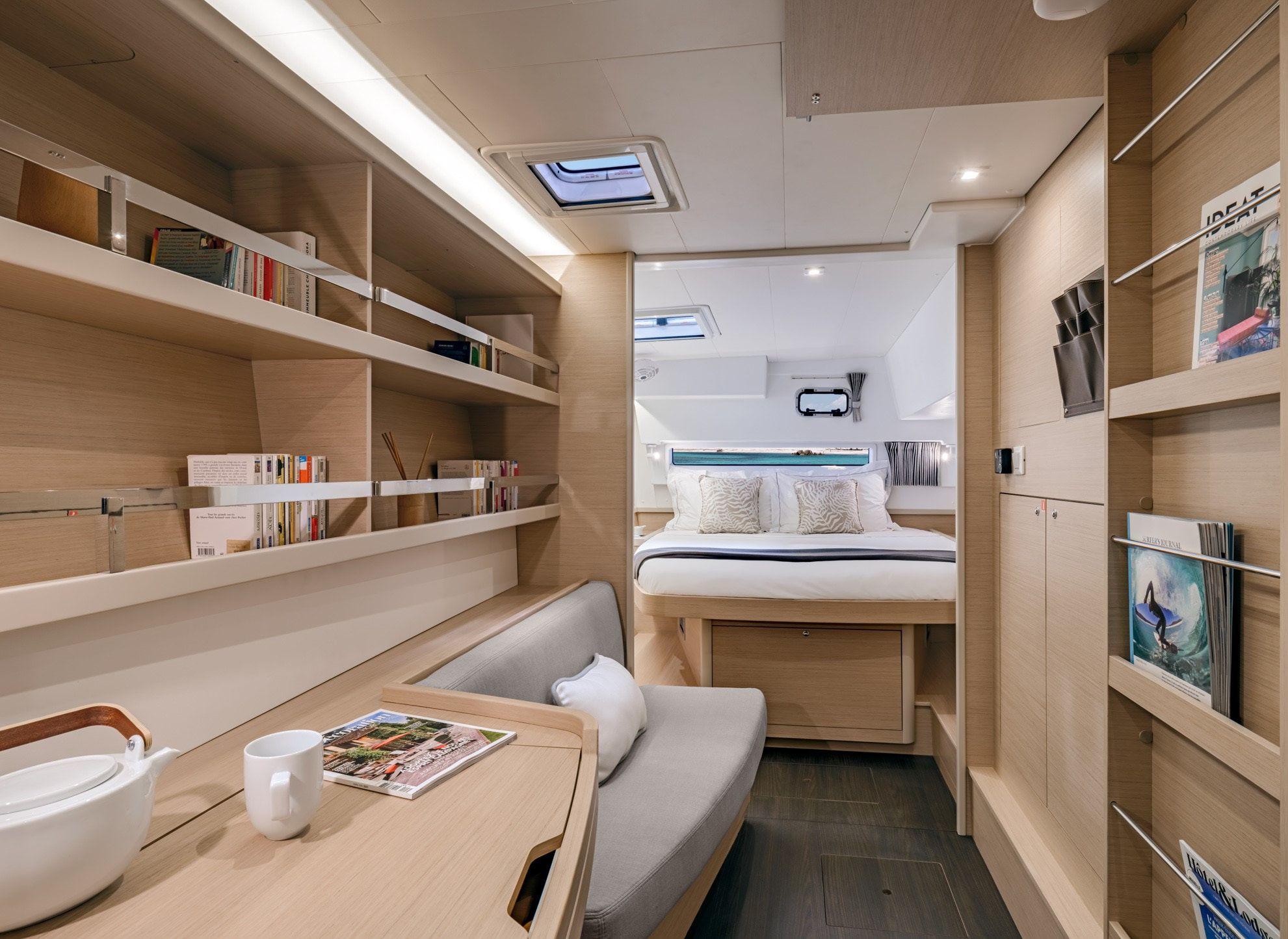
After a day filled with both work and swimming, your cabin becomes a personal retreat. A full-size bed, fresh air, soft lighting, and quiet surroundings help you recover and wake up ready for the next day.
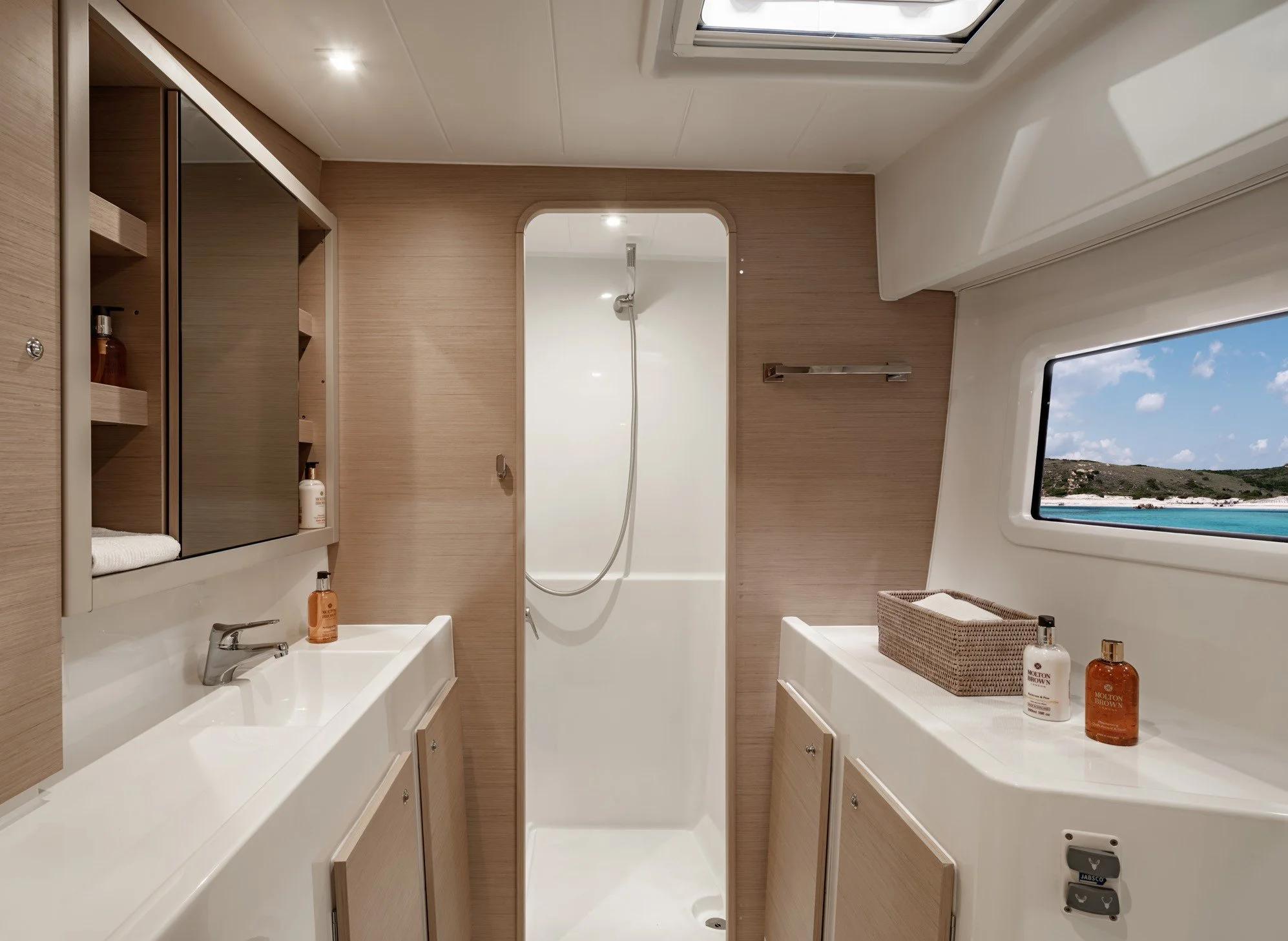
Head (Bathroom)
The head on a modern catamaran is a fully equipped bathroom with a marine toilet, sink, mirror, and shower. Thanks to the width of the twin hulls, the space feels noticeably more comfortable than on most monohull yachts — closer to a compact apartment bathroom than a typical boat setup.
What the week looks like
Anchored mornings for deep work, afternoons under sail, evenings on deck. Tap any photo to see it bigger.
Marmaris — Departure
The starting point — a vibrant marina town with a 16th-century castle, a winding bazaar, and excellent boat provisioning. We depart in the afternoon and anchor in the first quiet bay within a few hours.
Bozburun
A sleepy fishing village on the Hisarönü Gulf, famous for its traditional gulet (wooden schooner) builders. A perfect work morning in the cockpit followed by a swim in calm, crystal-clear water.
Selimiye
A hidden bay framed by pine-covered hills and a small village of whitewashed houses. Excellent snorkelling, a handful of waterfront restaurants, and reliably fast marina Wi-Fi for the afternoon calls.
Palamutbükü
One of the most beautiful wild beaches on the Datça Peninsula — a long pebble shore backed by fig and olive trees. The turquoise water is some of the clearest in the Aegean; a natural recharge between two work days.
Knidos — The Highlight
The jewel of the route — an ancient Greek city at the very tip of the Datça Peninsula, founded in the 4th century BC and famous for the Temple of Aphrodite and its lighthouse. Anchor in one of two natural harbours and explore the ruins at sunset.
Datça
The main town of the peninsula — a relaxed place with good restaurants, a traditional market, and a hammam. Worth a morning at the local café with your laptop before an evening stroll and dinner ashore.
Return to Marmaris
The final passage home — a comfortable 40-mile run, often with a tailwind. One last swim stop in a bay, then back to the marina in time for evening flights.
A spacious catamaran
It is more than a boat — it’s a floating living and working environment designed for comfort, balance, and freedom. Wide decks, bright panoramic interiors, and separate living areas create a sense of openness that you rarely feel at sea. Multiple social zones allow people to work, relax, and connect without getting in each other’s way.
Everything about our workations in Turkey
'Will the internet really work?' 'What if I get seasick?' 'Do I need sailing experience?'—everyone asks these before their first trip. We've run several voyages and know what concerns people most. Below are honest answers based on real participant experiences. Didn't find your question? Write us—we'll tell you more.
We use Turkish 4G LTE — Turkcell and Vodafone both deliver 30–80 Mbps along the entire Turquoise Coast, which is enough for HD video calls, screen sharing, and large file uploads. Routes are planned in advance around known stable-coverage zones, and at anchor in popular bays you'll typically see two or three bars of signal. For peace of mind we also carry mobile hotspots from both carriers, so a single network outage never takes the whole yacht offline.
There is a stable 4G connection for video calls 90% of the time. Brief drops are possible during sharp yacht maneuvers or in remote bays, but we choose anchorages considering connection quality. For critical meetings, we recommend scheduling them for morning hours when the yacht is at a stable anchorage.
We coordinate sailing schedules with your work schedule. Important meetings are planned during anchorage times. If a meeting is critical, we can stay at anchorage longer or reschedule the passage.
Starlink uses encryption, but if you need VPN for corporate systems, it works without issues. For particularly sensitive data, we can arrange shore access to coworking spaces or cafes with wired internet in major cities (Fethiye, Marmaris, Bodrum).
Several options: cockpit (open deck with sun shade and table), saloon (enclosed space with AC and large table), foredeck (for those who like working in the sun). Each location has 220V outlets and internet access.
Mornings at anchorage are very quiet—just sea sounds and seagulls. During passages there's engine noise and wind in the sails (when sailing), but passages are usually midday after work blocks end. If you need absolute silence for a call, you can go to your cabin with noise-canceling headphones.
Most participants work 4-6 hours concentrated (typically 9:00-13:00 and another 1-2 hours after lunch if needed). This is more effective than 8-10 hours of scattered work at home. We don't impose schedules—everyone works at their own pace, but passages are usually planned for afternoons.
Turkey is GMT+3. If you work with Europe (GMT+1/+2), it's convenient—meetings during the day. With USA (GMT-5/-8) it's trickier—you'll need early mornings or evening work. We consider this when planning activities: if you have evening calls, daytime activities will be earlier.
No, but in port cities (Fethiye, Göcek, Marmaris) there are copy centers we can visit if needed. For most remote work tasks this isn't required, but if necessary—we'll arrange it.
Double cabins with either a double bed or two single beds (separate mattresses), air conditioning, outlets, small wardrobe, porthole. Bathroom with shower shared between 2-3 cabins (depending on yacht). Clean linens and towels provided.
Yes, but the cost is higher (typically 40-50% surcharge on the berth price). If you're booking alone, we can match you with a like-minded roommate or provide a private cabin for the surcharge.
There are 220V European-standard outlets in every cabin, in the saloon, and in the cockpit, plus USB-A and USB-C ports in cabins and common areas. You can charge a laptop, phone, headphones, camera, and powerbank at the same time without tripping anything. Solar panels and the engine alternator keep the batteries topped up while at anchor, so power is never a constraint even on multi-day stays in remote bays.
Standard marine toilet (fresh water, works like regular but no paper in the toilet—use the bin). Shower with fresh water, hot water available. Large water supply, but we ask to conserve—good maritime practice.
Port towns along our routes — Marmaris, Göcek, Fethiye, and Bozburun — have laundromats and laundry services that wash and dry a full load for €5–7. We stop in port one or two times per week, which is enough for most 7-day cruises. You can also hand-wash quick-dry clothing on board: there's a dedicated drying line on the aft deck, and the Mediterranean sun does the rest in a couple of hours.
May-June: day +25-28°C, night +18-22°C. July-August: day +30-35°C, night +24-26°C. September-October: day +25-30°C, night +20-24°C. Cabins have AC. Deck is always cooler due to sea breeze. Nights can be cool—bring a light sweater.
Breakfast and dinner cooked onboard (Turkish and Mediterranean cuisine). Lunch either onboard or at coastal restaurants/tavernas (2-3 times per week). Always fresh vegetables, fruits, fish, meat. We shop at local markets.
Yes, inform us in advance: vegetarian, vegan, allergies, religious restrictions, intolerances. Turkish cuisine is very flexible—many vegetable dishes, legumes, fish. Gluten-free and lactose-free products available in major supermarkets.
The galley (kitchen) is accessible, but usually crew or rotating participants cook. If you want to prepare something yourself—please do. Gas stove, oven, refrigerator, freezer available.
No, alcohol is purchased separately (inexpensive and quality in Turkey). Usually participants pool money and buy wine/beer for evenings. Spirits available at duty-free or specialized shops (Turkey has restrictions on spirits sales).
Coffee and tea included. Turkish coffee pot (cezve), French press, sometimes coffee machine (depends on yacht). Bring your favorite coffee if you have specific preferences—basic Arabic coffee provided, but specialty varieties better to bring.
No. A professional captain with 18+ years of experience operates the yacht. No skills required from you. If you want to learn—the captain will gladly show you the basics.
The Turkish coast is one of the calmest in the Mediterranean. Fethiye and Göcek gulfs are especially protected. Strong waves are rare. If you're prone to seasickness: bring anti-nausea tablets (Dramamine), wristbands, ginger. First 1-2 days the body adapts. No waves at anchorage.
Yes, complete maritime first aid kit: painkillers, fever reducers, antiseptics, bandages, anti-nausea medication, antihistamines. If you have chronic conditions—bring your medications with extras.
Usually 0.5-5 nautical miles from coast. Most passages are along the shore with constant land visibility. Open passages without shore are virtually non-existent on Turkish routes.
Onboard: satellite communication, life jackets, life raft, flares, fire extinguishers, full first aid kit. Captain certified in first aid. Always within Turkish coast guard reach (15-30 minutes by boat). Hospitals in port cities.
We strongly recommend travel insurance that explicitly covers water sports, sailing, and boat-based activities. A suitable weekly policy costs €20–40. Turkish healthcare is high-quality but paid for foreigners — a private clinic visit can run €80–150 without insurance, and a hospital stay much more. Make sure your policy includes medical evacuation and a 24/7 assistance line; both are standard on most European travel insurance products.
Most voyages start from Göcek or Fethiye. Nearest airport is Dalaman (DLM). Flight from Moscow/Istanbul ~2-3 hours. Airport-marina transfer 30-40 minutes, we arrange for €20-30 per person or explain how to get there independently (bus €3-5).
Russians, Ukrainians, Belarusians don't need visa for stays up to 60-90 days. Other nationalities—check visa requirements. Most nationalities get e-visa online for $50-60.
Voyage usually starts Saturday afternoon (14:00-16:00), ends next Saturday morning (by 10:00). Optimal: arrive Friday evening or Saturday morning, depart Saturday afternoon or Sunday. We can help with hotel for night before/after.
Technically yes, but it's both inconvenient and not cost-effective. A full week is the optimal length for both pricing and the onboard experience, since the first and last days are partly travel logistics. Mid-voyage pickups also depend on whether the yacht's planned route happens to pass an accessible port on the day you need. If you have strict date constraints — for example a wedding mid-week — write to us and we'll discuss individually whether a partial booking is feasible.
The price includes yacht accommodation in a private cabin, the captain's services and salary, fuel for the entire route, all port and marina fees, fresh linens and towels, 4G mobile internet for the group, basic snorkelling masks and fins, and end-of-cruise yacht cleaning. Drinking water and basic galley supplies are also covered. Meals on board, lunches ashore, excursions, transfers, and personal expenses are not included unless your specific cruise listing says otherwise.
Flight to Turkey, airport transfer (we can arrange), restaurant lunches (€10-20 per person), alcohol, personal expenses, shore excursions, scuba diving (if with tank), captain gratuity (optional, usually 5-10%).
Booking: 50% deposit (non-refundable but transferable to other dates if available). Balance: 14 days before voyage start. Payment: bank transfer, PayPal, cryptocurrency (USDT). No cash accepted onsite—cashless only.
Deposit non-refundable but transferable to another voyage (if available, 30+ days before start). If we cancel (weather, yacht breakdown)—full refund or transfer. We recommend trip cancellation insurance.
Yes. Teams of 6 or more get a 10–15% group discount. A full yacht charter — booking all 8 berths for one company or community — is more cost-effective than booking individual seats and gives you complete control over the itinerary, the workday rhythm, and team activities. For corporate offsites we discuss custom terms including invoicing through a Turkish entity, multi-yacht charters for larger teams, and add-ons like facilitated workshops or chef-prepared meals.
May-June: comfortable temperature (+25-28°C), fewer tourists, green nature, lower prices. Perfect for those who don't like heat. July-August: hot (+30-35°C), warm sea (+26-28°C), many tourists, higher prices. For swimming and sunbathing lovers. September-October: golden middle (+25-30°C), sea still warm (+24-26°C), fewer crowds, comfortable work.
Turkish coast is one of the most protected. Storms are rare, especially in summer. We monitor forecasts and don't go out in bad weather. If caught at anchorage—we simply stay in protected bay, work as usual. Yacht sits stable.
Technically yes, but comfortable May-October. November-April: cool (+15-20°C), rain, less infrastructure operating. We don't run winter voyages in Turkey—we move to Caribbean or Seychelles then.
For both. If you want to socialize—evenings and activities offer plenty of interaction. If you want quiet—you can work in cabin with headphones, read on foredeck, swim alone. No forced socializing, but atmosphere is friendly.
No. 40-50% of participants come solo. Friendly connections usually form quickly—common interests (remote work, travel, sailing) unite people. Many stay in touch after the voyage.
Remote workers: developers, designers, marketers, freelancers, entrepreneurs. Age 25-45 (with exceptions). Active, open to new experiences, often with interesting hobbies (climbing, paragliding, motorcycles, racing). People who value work-life balance.
Main languages: Russian and English. Most participants speak both at least at basic level. Captain speaks Russian and English. Turkish not required—everyone speaks English in tourist areas.
Yes, but note: this is a workation, not vacation. Everyone works mornings, activities afternoon/evening. If partner is ready to entertain themselves mornings (reading, swimming, exploring shore)—great. Same price.