 Wild Workation
Yacht Workation in the Cyclades
A 7-day yacht workation through the iconic Cyclades — Santorini's volcanic caldera, Paros' turquoise coves, Naxos' ancient marble towns, and Milos' dramatic sea caves. Work remotely from a catamaran with 4G internet, swim in crystal-clear Aegean waters, and catch sunsets that have inspired artists for centuries.
Seven-day yacht workation through the iconic Cyclades — Santorini's volcanic caldera, Paros's turquoise coves, Naxos's ancient marble towns, and Milos's dramatic sea caves. From €1,300 per person with the early-bird discount, €1,500 at the standard rate, or €2,400 for a private cabin for two. All-inclusive(except food): Greek 4G/LTE along the islands, onboard Starlink for open-sea legs, private cabins, fuel, marina fees, and a professional skipper. Ideal for remote workers and digital nomads who want equal parts culture and sea — archaeological sites, Mediterranean cuisine, and the famous white-and-blue island architecture. The hook: daily anchorages at islands you can't reach by ferry, Aegean sunsets over the caldera, and morning Zoom calls with Santorini as your background.
In the fixed price
- A spot on the catamaran (accommodation in a shared double cabin).
- Bedding and Towels
- Skipper services
- Motorboat (dinghy)
- Internet support
Not included
- Air tickets
- Transfer to and from the marina
- Marina fees and provisions
- Sightseeing and onshore entertainment
- Personal spendings
- Damage Policy
7-Day Route: Athens to the Caldera
Kea (Tzia)
The first stop after Lavrio — Kea is just 12 nautical miles from the mainland. Despite its proximity to Athens, it stays uncrowded: no cruise ships, only small yachts and local fishing boats. Green hills, narrow terraces of oaks and oleanders, and inland the famous Kea Lion — a 6th-century BC stone sculpture carved from a single rock. A gentle start to the workation rhythm: morning work at anchor, a short afternoon passage.
Kythnos — Kolona Beach
Kythnos is known for Kolona beach — a double crescent of turquoise water where a narrow strip of land divides two bays. Anchoring on either side of the isthmus and choosing your morning swim is one of the small pleasures of this route. In the hillside village of Dryopida — authentic Cycladic architecture without tourist crowds. The thermal spring in Loutra village is perfect for a relaxing evening after a full workday.
Serifos — Hilltop Chora
Serifos presents one of the most dramatic silhouettes in the Aegean: its dazzling white chora perches on a sheer cliff 200 metres above sea level. The anchorage at Livadi is sheltered and calm, with good 4G. The walk up to the chora takes 30 minutes on a cobblestone path and opens views across the entire western archipelago. One of the most authentic islands on the route — local life here has barely changed in decades.
Sifnos — Gastronomy & White Villages
Sifnos is known for two things: traditional pottery and the best food in the Cyclades. The island gave Greece its first famous chef — Nikolaos Tselementes — and his culinary legacy is still very much alive. Anchoring at Platis Gialos means a long sandy beach with crystal water and tavernas just steps from the shore. The hilltop chora of Apollonia and the medieval Chrysopigi monastery perched on a rock above the sea are essential stops during the afternoon break.
Milos — Kleftiko Sea Caves
Milos is a volcanic island with the most unusual landscapes in the Cyclades. Kleftiko on the south-west coast is a maze of white rock formations, sea arches, and caves accessible only by water. Sailing into the caves, kayaking through the passages, and photographing the turquoise light inside is the standard programme. In the village of Klima on the waterfront — colourful syrmata, fishermen's houses with boat garages opening directly onto the sea. This is also where the Venus de Milo was discovered.
Folegandros — Untouched Cliffs
Folegandros is one of the most unspoiled islands in the Cyclades. Cliffs up to 300 metres drop straight into the sea, and the chora stands on their edge, visible from far out at sea. No mass tourism, no cruise ships — just a handful of yachts in the small harbour of Karavostasis. Work mornings here are unusually productive: silence, a steady anchor hold, and views of sheer rock walls. Evening walks through the medieval chora make the perfect ending to the last full day before Santorini.
Santorini — The Caldera
The final destination — the Santorini caldera, one of the most recognisable natural formations in the Mediterranean. The yacht anchors in the centre of a flooded volcanic crater 12 km wide, surrounded by cliffs up to 400 metres high. Oia on the northern clifftop, the half-submerged volcano Nea Kameni in the caldera centre, thermal springs at Palea Kameni — all within an hour by dinghy. Watching the sunset from inside the caldera, with the sun dropping behind the rim, is the classic ending to a seven-day passage.
Deep work in the morning, sailing in the afternoon
Where do we spend our time
Our fleet will consist of one or more comfortable catamarans. On board each one, you’ll find everything needed for living: four or five cabins with comfortable beds and storage, two to three bathrooms with showers and hot water, and a spacious saloon with a kitchen. And of course, Wi-Fi internet.
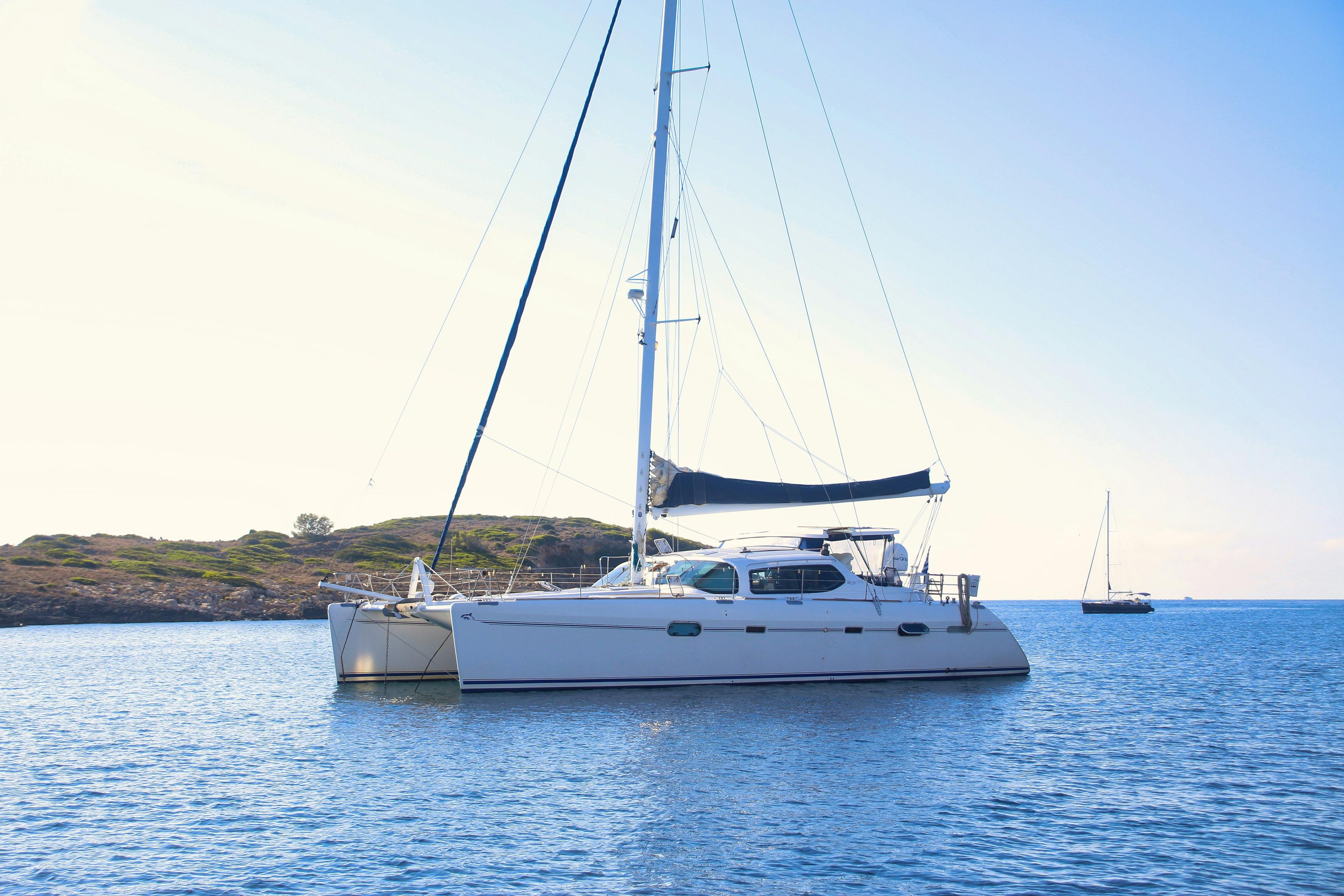
A spacious catamaran
It is more than a boat — it’s a floating living and working environment designed for comfort, balance, and freedom. Wide decks, bright panoramic interiors, and separate living areas create a sense of openness that you rarely feel at sea. Multiple social zones allow people to work, relax, and connect without getting in each other’s way.
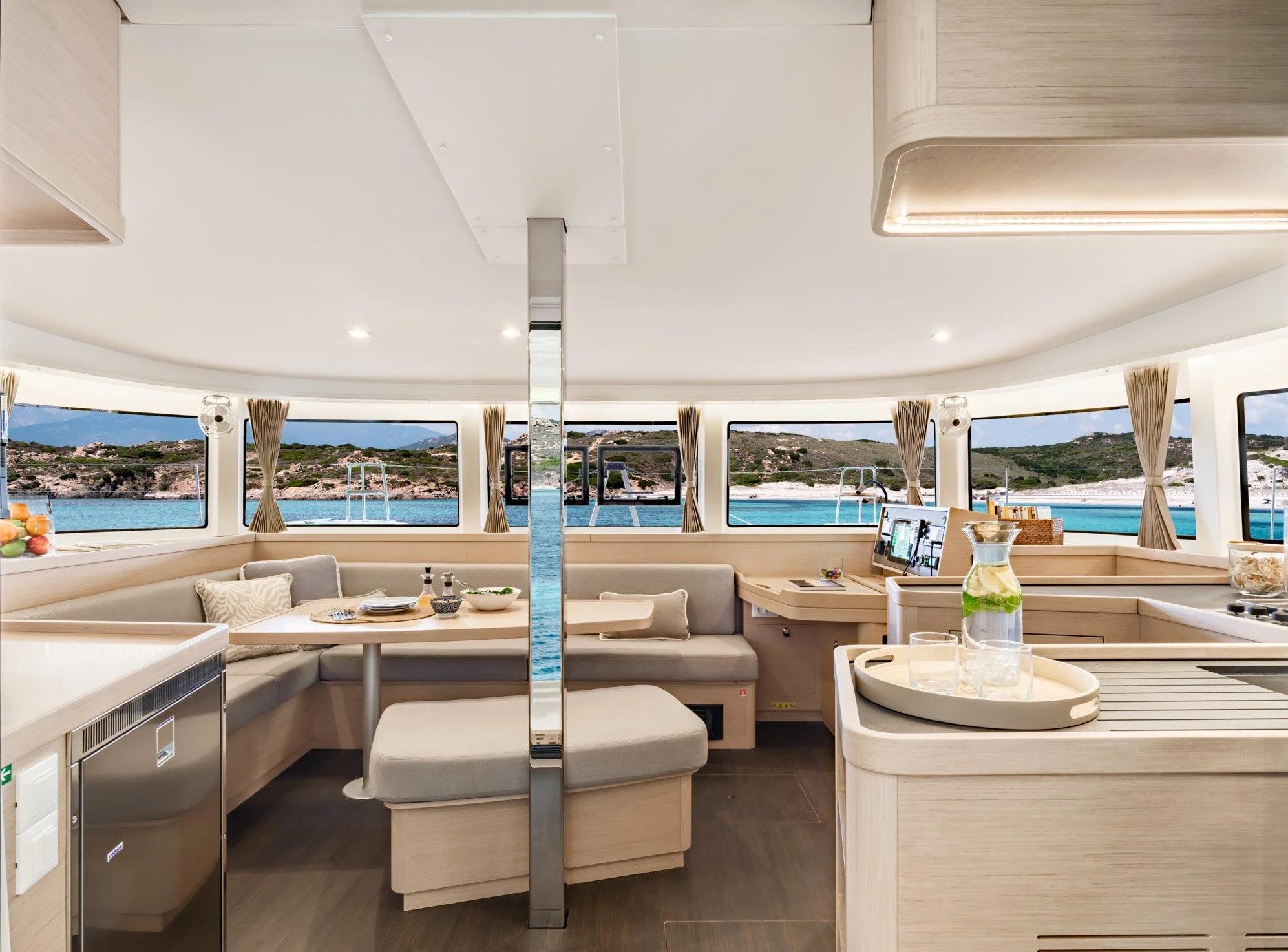
The panoramic saloon
The panoramic saloon is a quiet workspace protected from sun and wind. A large table, a nearby kitchen, and a stable surface for your laptop make it feel like a bright office in the middle of the sea. Perfect for deep-focus work, planning sessions, and long conversations with your team.
Cockpit
The cockpit naturally turns into a coworking area: a large table, shade from the bimini, power outlets, and a steady daily rhythm. This is where work sessions, brainstorms, and sunset dinners happen after tasks are done. The sea is right there, but work doesn’t stop — it just feels lighter. It’s a place where Slack calls can end with a jump into the water, and ideas come faster than they do in an office.
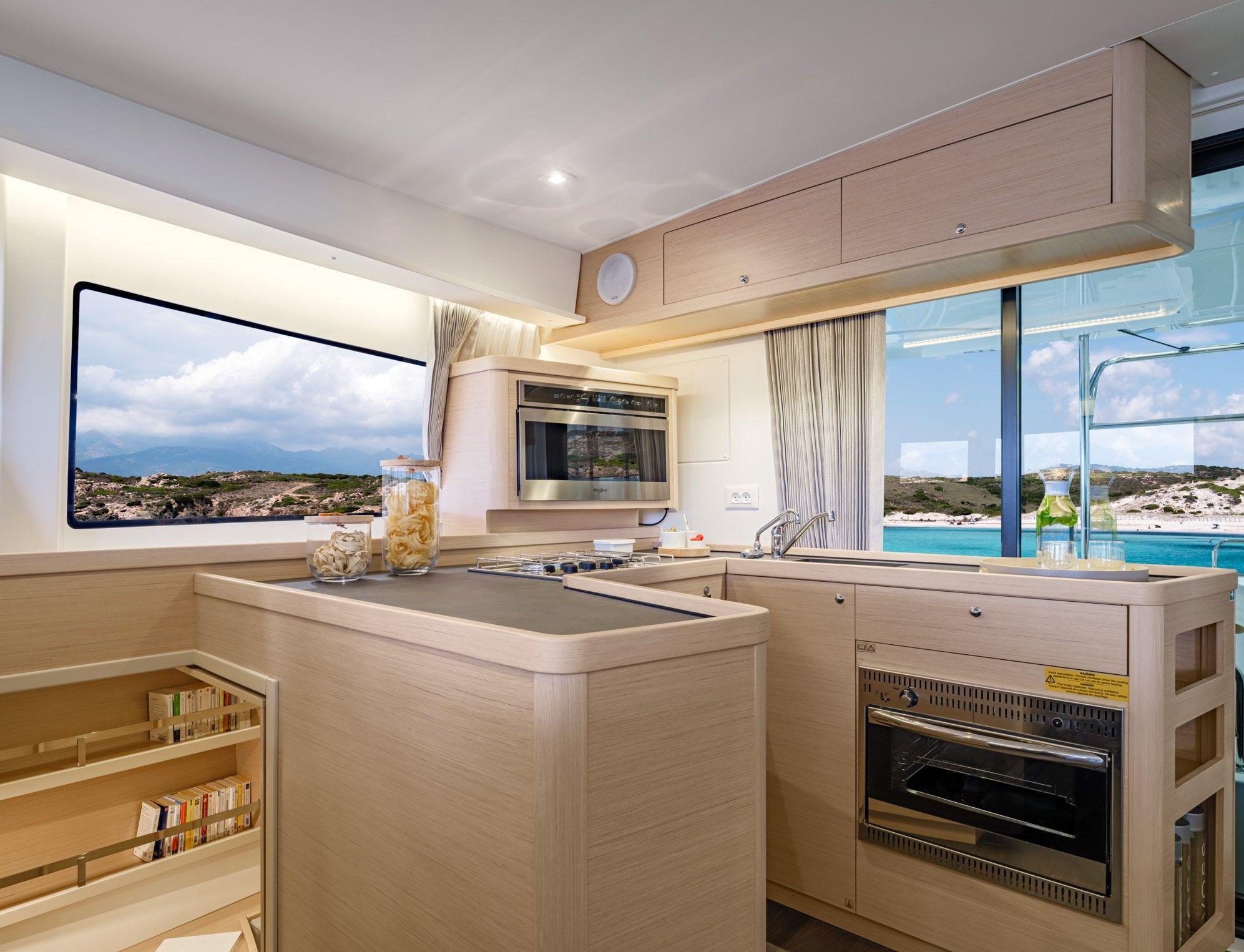
Kitchen area (galley)
It is designed to feel closer to a compact apartment kitchen than a typical boat setup. With generous counter space, a stove, refrigerator, sink, and plenty of storage, cooking on board becomes easy and social rather than purely functional. Because the galley is usually integrated with the saloon and cockpit, it naturally becomes part of daily life on board. You can prepare breakfast while talking with the crew, make coffee between meetings, or cook dinner together after a day of work and swimming.
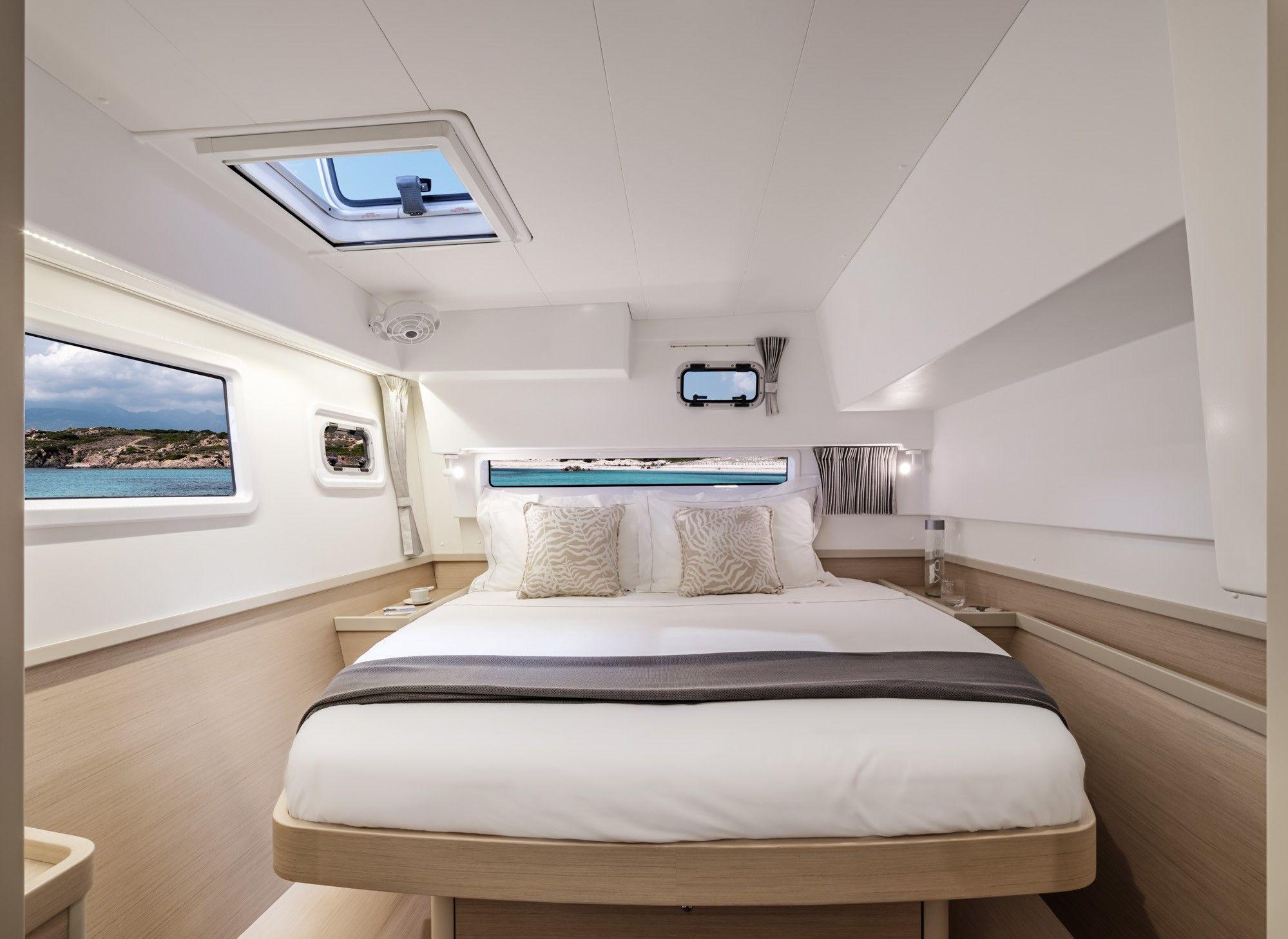
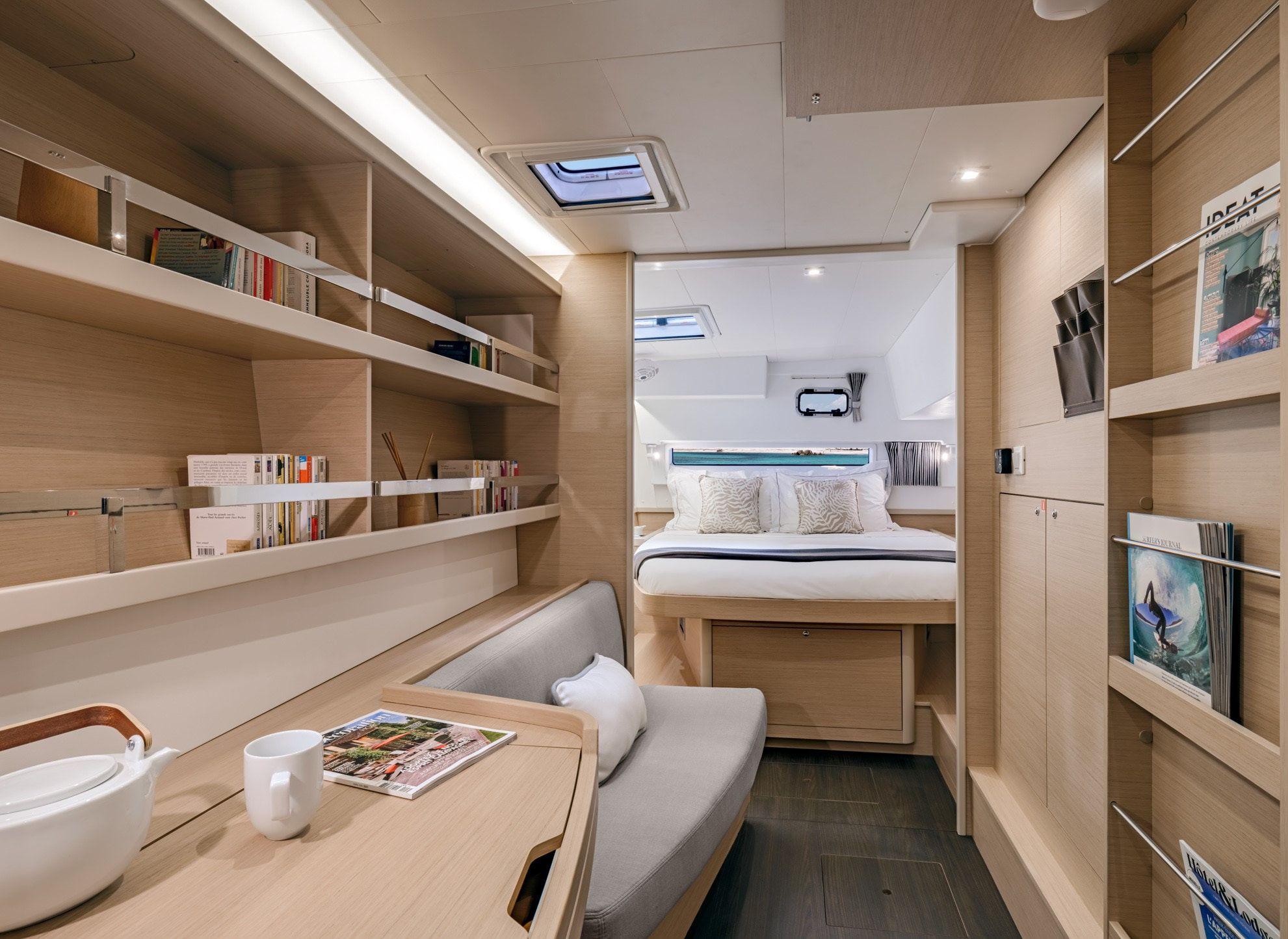
Cabins
After a day filled with both work and swimming, your cabin becomes a personal retreat. A full-size bed, fresh air, soft lighting, and quiet surroundings help you recover and wake up ready for the next day.
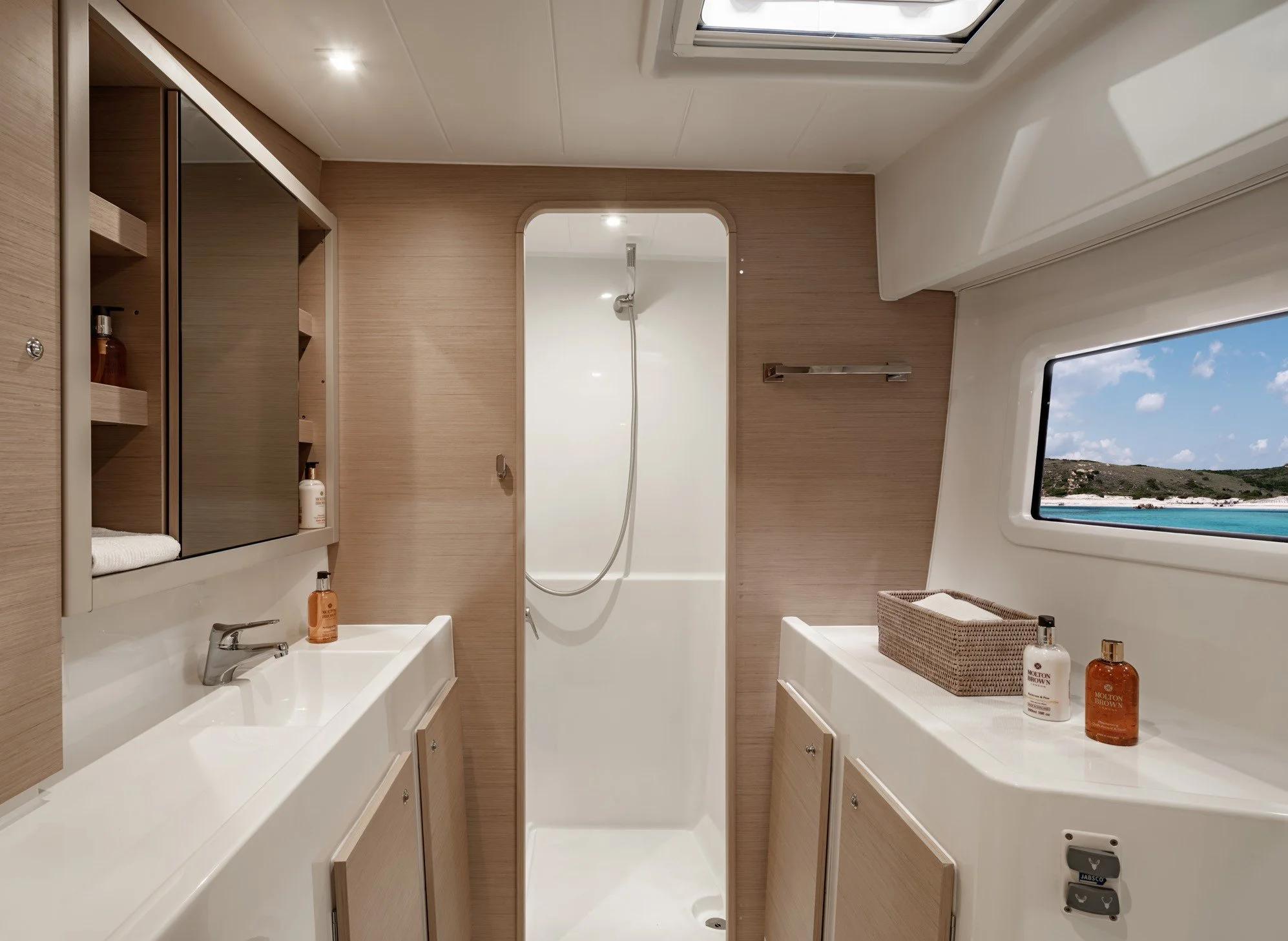
Head (Bathroom)
The head on a modern catamaran is a fully equipped bathroom with a marine toilet, sink, mirror, and shower. Thanks to the width of the twin hulls, the space feels noticeably more comfortable than on most monohull yachts — closer to a compact apartment bathroom than a typical boat setup.
What the week looks like
Anchored mornings for deep work, afternoons under sail, evenings on deck. Tap any photo to see it bigger.
Kea (Tzia)
The first stop after Lavrio — Kea is just 12 nautical miles from the mainland. Despite its proximity to Athens, it stays uncrowded: no cruise ships, only small yachts and local fishing boats. Green hills, narrow terraces of oaks and oleanders, and inland the famous Kea Lion — a 6th-century BC stone sculpture carved from a single rock. A gentle start to the workation rhythm: morning work at anchor, a short afternoon passage.
Kythnos — Kolona Beach
Kythnos is known for Kolona beach — a double crescent of turquoise water where a narrow strip of land divides two bays. Anchoring on either side of the isthmus and choosing your morning swim is one of the small pleasures of this route. In the hillside village of Dryopida — authentic Cycladic architecture without tourist crowds. The thermal spring in Loutra village is perfect for a relaxing evening after a full workday.
Serifos — Hilltop Chora
Serifos presents one of the most dramatic silhouettes in the Aegean: its dazzling white chora perches on a sheer cliff 200 metres above sea level. The anchorage at Livadi is sheltered and calm, with good 4G. The walk up to the chora takes 30 minutes on a cobblestone path and opens views across the entire western archipelago. One of the most authentic islands on the route — local life here has barely changed in decades.
Sifnos — Gastronomy & White Villages
Sifnos is known for two things: traditional pottery and the best food in the Cyclades. The island gave Greece its first famous chef — Nikolaos Tselementes — and his culinary legacy is still very much alive. Anchoring at Platis Gialos means a long sandy beach with crystal water and tavernas just steps from the shore. The hilltop chora of Apollonia and the medieval Chrysopigi monastery perched on a rock above the sea are essential stops during the afternoon break.
Milos — Kleftiko Sea Caves
Milos is a volcanic island with the most unusual landscapes in the Cyclades. Kleftiko on the south-west coast is a maze of white rock formations, sea arches, and caves accessible only by water. Sailing into the caves, kayaking through the passages, and photographing the turquoise light inside is the standard programme. In the village of Klima on the waterfront — colourful syrmata, fishermen's houses with boat garages opening directly onto the sea. This is also where the Venus de Milo was discovered.
Folegandros — Untouched Cliffs
Folegandros is one of the most unspoiled islands in the Cyclades. Cliffs up to 300 metres drop straight into the sea, and the chora stands on their edge, visible from far out at sea. No mass tourism, no cruise ships — just a handful of yachts in the small harbour of Karavostasis. Work mornings here are unusually productive: silence, a steady anchor hold, and views of sheer rock walls. Evening walks through the medieval chora make the perfect ending to the last full day before Santorini.
Santorini — The Caldera
The final destination — the Santorini caldera, one of the most recognisable natural formations in the Mediterranean. The yacht anchors in the centre of a flooded volcanic crater 12 km wide, surrounded by cliffs up to 400 metres high. Oia on the northern clifftop, the half-submerged volcano Nea Kameni in the caldera centre, thermal springs at Palea Kameni — all within an hour by dinghy. Watching the sunset from inside the caldera, with the sun dropping behind the rim, is the classic ending to a seven-day passage.
A spacious catamaran
It is more than a boat — it’s a floating living and working environment designed for comfort, balance, and freedom. Wide decks, bright panoramic interiors, and separate living areas create a sense of openness that you rarely feel at sea. Multiple social zones allow people to work, relax, and connect without getting in each other’s way.
Everything About Our Yacht Workation in the Cyclades, Greece
"Does internet really work in the Aegean?" "What on earth is the Meltemi?" "Do I need a Schengen visa?" — everyone asks these before their first yacht workation in Greece. Below are honest, fact-specific answers based on real experience sailing the Cyclades with remote-working crews.
A yacht workation is a remote work format where you live and work aboard a sailing catamaran while moving between islands or anchorages. Mornings are a focused work block on the yacht with 4G internet; afternoons are a sail to the next stop; evenings are for swimming, shore, and dinner. Wild Workation runs 7-day yacht workations in the Cyclades, Greece, for both teams and individual remote workers.
Yes — and it works better than most people expect. Greek carriers Cosmote and Vodafone Greece provide reliable 4G across the Cyclades archipelago. The catamaran carries an onboard 5G router with a local SIM. Participants on our voyages successfully run Zoom calls, deploy code, use cloud tools, and hold team meetings — all from anchor in the Aegean Sea.
The internet is reliable: Cosmote and Vodafone Greece provide 4G LTE coverage at most anchorages along the Lavrio–Kea–Kythnos–Serifos–Sifnos–Milos–Folegandros–Santorini route. The catamaran carries an onboard 5G router that automatically selects the strongest network. Real-world speeds at anchor: 20–50 Mbps — sufficient for video calls, cloud work, and file transfers.
Video calls are stable around 90% of the time. Brief drops can occur during inter-island passages or in very remote coves. We plan routes with coverage zones in mind and recommend scheduling critical calls for morning hours — when the yacht is at anchor, the signal is most consistent.
Passages between Cycladic islands cover 15–30 nautical miles and are planned for after midday — once the main work block (9:00–13:00) is done. If a meeting falls during a passage, we can adjust the schedule: depart later or anchor in an intermediate bay with good signal.
The catamaran has three work zones: (1) Cockpit — the open stern deck with a sun shade, large table, and 220V outlets; (2) Panoramic saloon — an enclosed, air-conditioned space protected from the Meltemi and heat, with a table for 6–8 people; (3) Foredeck — for those who prefer working in the sun by the water. Internet and power are available at every spot.
The Meltemi is a seasonal northern wind in the Aegean, blowing from June to September. It is predictable, cools the heat, and creates good sailing conditions. When the Meltemi exceeds force 5–6 we stay at anchor in sheltered bays — the best time for deep focused work: quiet, cool, no distractions. The Meltemi does not disrupt remote work; it only affects passages, which we plan for calmer parts of the day anyway.
Most participants work 5–6 focused hours per day — typically 9:00 to 13:00–14:00. That is comparable to a productive meeting-free office day. Passages are planned for the afternoon, so work mornings are untouched. An evening session (1–2 hours) is possible when needed — after swimming, before dinner.
Greece is GMT+2 in winter, GMT+3 in summer (EEST). This is convenient for working with Europe (CET/CEST): meetings fall in the first half of the day. Working with US teams (EST/PST) requires early morning or evening calls — we factor this into the daily activity schedule.
Cabins are double: a double bed or two singles, air conditioning, 220V outlets, a small wardrobe, and a porthole. Hot-water shower bathrooms are shared between 2–3 cabins depending on the yacht. Bedding and towels are provided. Cabin size is comparable to a compact hotel room.
Yes — with a 40–50% surcharge: you occupy a double cabin alone. If you are travelling solo without the surcharge, we match you with a cabin mate with a similar schedule and interests.
220V outlets are in cabins, saloon, and cockpit. USB-A and USB-C ports are in cabins and common areas. The electrical system runs on shore power in marinas and from a generator or inverter underway. You can charge a laptop, phone, and powerbank simultaneously without any restrictions.
Breakfast and dinner are cooked on board — Greek and Mediterranean cuisine: fresh fish and seafood, olive oil salads, moussaka, dolma, pita with hummus. 2–3 times a week we lunch at tavernas ashore. Groceries are bought together at markets on the larger islands (Kea, Sifnos, Santorini) and paid separately — they are not included in the berth price.
Yes — inform us at booking: vegetarian, vegan, allergies (gluten, lactose, nuts, shellfish), religious restrictions. Greek cuisine is inherently rich in plant-based dishes: spanakopita, fasolada, revithia, tzatziki. Gluten-free and lactose-free products are available at supermarkets on Santorini, Naxos, and Syros.
No — alcohol is purchased separately. Greece has no alcohol sales restrictions: wine, beer, and ouzo are available at any supermarket and taverna. Local wines are especially good — Assyrtiko from Santorini, Moschofilero from the Peloponnese — at €8–15 per bottle from a shop.
No experience is needed. The yacht is operated by a licensed skipper experienced in Aegean sailing. Participants need no prior skills. If you want to learn the basics of sailing — the skipper will happily teach you during the voyage itself.
The Aegean can produce noticeable short chop during the Meltemi — especially on open stretches between islands. Anchorages are always calm. If you are prone to seasickness: bring Dramamine (dimenhydrinate), Sea-Band acupressure wristbands, or Scopoderm patches. The body adapts within 1–2 days. We plan passages for the calmest part of the day.
Onboard: satellite and VHF radio, life jackets, life raft, flares, fire extinguishers, maritime first aid kit. The skipper holds a maritime first aid certificate (STCW). The Greek Coast Guard (Limenikó Sóma) operates 24/7 and responds within 20–40 minutes. Nearest hospitals: Santorini (Fira), Naxos, and Syros. Helicopter evacuation to Athens is available.
Yes — we strongly recommend travel insurance with water sports and activities coverage (around €20–40 per week). Medical care in Greece is paid for non-EU tourists: insurance covers treatment, repatriation, and trip cancellation. EU citizens can use their EHIC card.
The voyage starts from Lavrio — a port 50 km south-east of Athens International Airport (ATH / Eleftherios Venizelos). Taxi ATH–Lavrio: ~€50–60, 40–50 minutes. Bus: X96 to Piraeus, then KTEL to Lavrio — around €10–12 and 2 hours. We recommend arriving Friday evening: overnight in Athens, Saturday morning to Lavrio. We send detailed transfer instructions after booking.
Greece is a Schengen zone country. EU and Swiss citizens need no visa. Russian, Belarusian, and Ukrainian citizens require a Schengen Type C visa — apply 4–8 weeks in advance. Citizens of most other non-EU countries need a Schengen visa or the ETIAS online travel authorisation (introduced in 2025). Check requirements for your passport at eu-visa.info.
The voyage starts Saturday at 14:00–16:00 in Lavrio and ends the following Saturday morning (by 10:00). Optimal: arrive Friday evening or Saturday before 12:00, depart Saturday after 14:00 or Sunday. We help arrange a hotel in Athens for the night before or after.
The standard 7-day route: Lavrio (start) → Kea → Kythnos (Kolona beach) → Serifos (hilltop chora) → Sifnos (gastronomy, Platis Gialos) → Milos (Kleftiko sea caves) → Folegandros (untouched cliffs) → Santorini (caldera, finish). All stops are western Cyclades; passages are 15–30 nautical miles. The route can be adjusted for weather and group preferences.
A berth on the 7-day Cyclades workation costs: €1,300 (early bird), €1,500 (standard single berth), or €2,400 (full cabin for two). Included: catamaran accommodation, skipper, fuel, port fees, bedding, onboard 5G internet, basic snorkelling gear. Extra: flights, transfer to Lavrio, taverna lunches, and personal expenses.
Included: 7 nights on the catamaran, skipper services, fuel, anchorage and port fees, bedding and towels, 5G router with Greek SIM, basic snorkelling gear (mask, snorkel, fins), yacht cleaning.
Not included: flights to Athens (ATH), airport–Lavrio transfer (~€50 by taxi), taverna lunches ashore (€15–25 per person), alcohol, personal expenses, shore excursions, scuba diving, skipper gratuity (optional, typically 5–10% of the trip cost).
Booking: 50% deposit (non-refundable but transferable to another voyage if cancelled 30+ days ahead). Balance: 14 days before departure. Payment methods: bank transfer (IBAN), PayPal, USDT. Cash on arrival is not accepted.
Yes. Teams of 6+ people receive a 10–15% discount. A full yacht charter (8 berths) for a corporate offsite is more cost-effective than individual bookings. For corporate enquiries we discuss custom terms: tailored route, team-building programme, and a dedicated coordinator.
May–June: warm (+22–27°C), few tourists, lower onshore prices, green landscapes — ideal for those who dislike heat. July: peak season, +28–32°C, sea reaches +24°C, Santorini is crowded. August: hottest and windiest — Meltemi is strongest, better to choose more sheltered routes. September–October: the best choice for a workation — +25–30°C, sea still warm (+24–26°C), fewer tourists, Meltemi weaker.
The Meltemi is predictable — its cycles are known to the skipper in advance. At winds above force 5–6 (Beaufort) we stay in a sheltered bay or marina and reschedule the passage to the next day. At anchor there is no motion — the yacht sits still. This becomes the most productive work time: cool, quiet on board, no distractions. The route is flexible and adjusted to the weather in real time.
A yacht workation suits remote professionals who can structure their own day: developers, designers, marketers, analysts, freelancers, entrepreneurs. Participants are predominantly 25–45 years old. The key requirement: the ability to work independently in the mornings and manage your own schedule.
Yes — 40–50% of participants come solo. Shared interests (remote work, travel, the sea) bring people together naturally in the close quarters of a yacht. Connections form organically over shared dinners, swims, and evening conversations on deck. Many participants stay in touch long after the voyage.
Yes — the price is the same for all participants. The format to be aware of: mornings (9:00–13:00) are work time. If your partner is happy to explore ashore, read, swim, and enjoy Greece independently during those hours — this is a great joint trip format.